
Anatomy of The Ultra-Modern 40K Hobbyist: A Chat with Matt Aaron

A particular kind of hobbyist beginning to emerge from the wider Warhammer community — the kind of hobbyist that not even the Great Devourer could organically engineer without meticulous care.
This hobby entity isn't someone (something?) who paints, plays, or consumes the hobby in isolation, but someone who engages with every aspect of it holistically. Across the creative sphere, the competitive scene, and the broad mental space that connects both of these concepts together — these ultra-modern hobbyists are creatures that are breaking the mould.
It's a difficult balance to try and maintain. After all, it takes sustained energy, concentration, and time to excel in simply one aspect of the hobby, never mind all of them. The intensity, too, grows over time. Particularly as expectations start to rise across all fronts.
Exploring this concept with me is Matt Aaron, a 40K hobbyist (and genuinely genetically unmodified human being) who has earned great repute and acclaim amongst the Warhammer community over the years.
The Modern 40K Hobbyist — A Chat with Matt Aaron
Jamie M @B&B: Hello, Matt! Thanks for joining us at Brush & Bolter as we explore what we think is a really interesting emerging topic. I won't wax lyrical about your history too deeply, because you can describe that far better than I ever could — but let me say a little bit for the readers who aren't yet familiar with your journey: I think it's accurate to say that you're known for your successes at the highest levels of hobby competition. You maintain a strong presence in the competitive gaming scene, and within the wider creative community at large — so much so that you've come to represent the kind of hobbyist that takes a more complete approach to Warhammer.
It's clear you've chosen to make an investment in both the creative and competitive sides of the hobby. Beyond the hobby itself, you also have a strong professional background in psychology. All things considered, we think this makes you a pretty good person to ask about the perspective of the modern hobbyist.
Matt Aaron: Thank you, Jamie. I appreciate that warm introduction. You are correct that I find it personally rewarding to engage in both hobbying and playing aspects of Warhammer. I think one certainly influences the other, but both are fueled by members of the community. I think my background in clinical and sports psychology has given me a deep sense of empathy to connect with others, while helping them reach their own personal goals. My military background also gives me a slight tactical edge when approaching the game. It's not often that one can combine their personal careers with their hobby in such an amazing way, so I can't stress enough how blessed and humbled I am to be part of this.
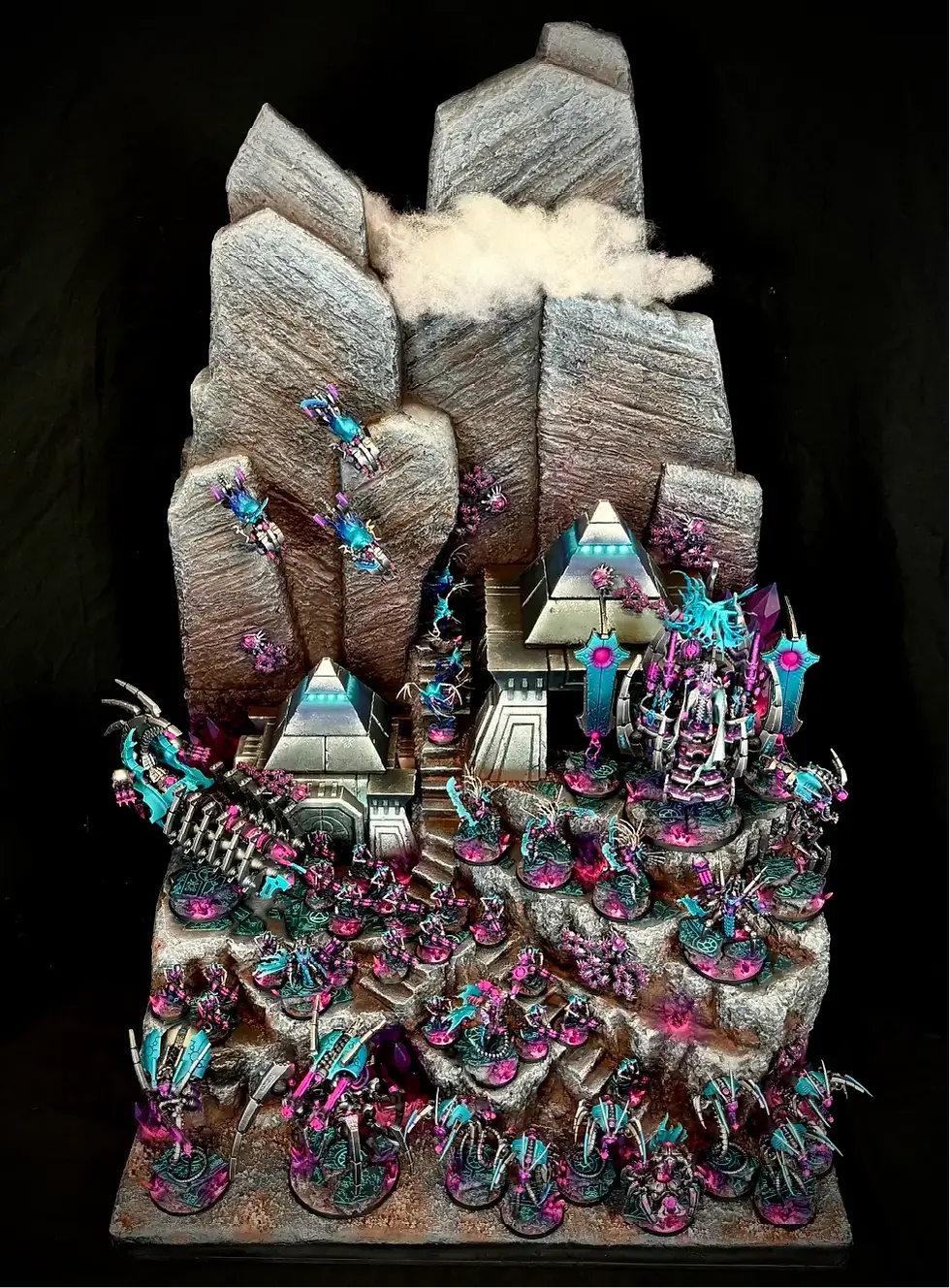
Finding the balance between the different aspects of the hobby
We talk about 'both' aspects of the hobby, but there may be other ways of looking at it. There's often a tendency for hobbyists to lean heavily into either the creative or the competitive — from my own standpoint I'll readily throw up my hands and admit that I'm firmly in the creative camp.
Jamie M: Matt, as a community, we talk about different aspects of the hobby — but at what point did these begin to feel connected for you, rather than separate pursuits? Did this shift happen naturally, or was it a deliberate effort?
Matt Aaron: That is a great question. To be honest, I first got into Warhammer 40,000 third edition as a teenager and absolutely hated the hobbying aspect of the game. I didn't have the patience to enjoy that process until I returned to the game while in graduate school at the tail-end of seventh edition. I think I really found the hobby-side of the game most appealing when I had more time to enjoy the process and found it fun to push my painting skills further. I also have a background in fine art painting, but modeling/sculpting/building was a new and exciting frontier. So I found myself naturally gravitating towards the hobby, but, I was deliberate in the specific technique I wanted to learn and develop. Jamie M: At the risk of sounding like a sadist, the fact that you had struggled with the hobby side of things is actually a little comforting. It just goes to show that at some point in the process we have all shared in some level of doubt or demotivation. I can really relate to the aches and pains of the love-hate relationship that is the painting — which I'm only really conquering in 2026 after 28 years in the hobby.

On what it actually means to "win" in the 40K hobby
Winning a competitive event and winning a hobby-focused event aren’t always the same thing, even if they sometimes overlap. 'Winning', as well, is something that's often best defined by the hobbyist in question — what makes one hobbyist tick might not be of any interest to another. While this may be the case, the hobby still rewards a more complete approach.
Jamie M: When you look back at your own results, what do you feel you’ve actually done well in those moments? Is it execution on the table, presentation of the army, or something less tangible that sits somewhere between?
Matt Aaron: I really like this question because while straight forward, it touches on so many complex issues. Just like with professional athletes, Warhammer has seen a specialization in one direction or the other due to continued growth and competition. To be successful at the highest levels, players often have to focus on one or the other to find success. So it is rare to achieve success in both without the discipline to stay on track and put the work in, dedication to reaching top performance, attention to detail, and a whole lot of luck (i.e. dice rolls going in your favor in key moments, key pairings at the tournament, and no models broken while being transported to the event, etc.).
Given my busy schedule, I am not able to attend more than a handful of events a year. So I have to be strategic in which events I attend and focus on those. Quality over quantity. Just like I spend hours and hours building and painting, I find a way to put that much time into playing the game and refining my skills. From finding players better than you to help make jumps in your game to watching youtube to improve a specific painting skill and trying out new techniques. In the end, everything takes time and you have to put in the time to create an opportunity to have success.

On psychology, decision-making, and the 40K tabletop
Jamie M: Your diverse background in everything from psychology to fitness brings a slightly different dimension to this. How much of your hobby effort is informed by your understanding of sports psychology, whether that’s in your discipline, decision-making, emotional control, or reading your opponent?
Matt Aaron: Honestly, I could give a whole college course on this topic because it's so multifaceted and complex. I think my knowledge of sports psychology helps me refine and polish my activities in being an athlete (i.e. playing sports in high school/college, military-level physical fitness, and being a certified fitness instructor, etc). My education in psychology helps target specific issues quicker, comprehend them, and address them with efficiency.
I think my natural temperament is to be easy-going and mature, yet, to know when it's time to have a little fun with our plastic models in a fantasy game that other people want to share and have fun with. For both the hobby and gaming side, discipline and decision-making is also at a premium. You want to make smart decisions in the game, and also want to make smart decisions with your time with how you paint your army, so you avoid taking 5 years to paint it.
As far as gameplay, I would describe myself as an excited but also a relaxed player. I try to put in a good effort but I realize it is just a game and the goal is to have fun. I also try to ensure that while we're having a good competitive game and pushing to our respective limits, I want my opponent to have fun, too.
This can look different for different people and we have to respect that. Once I noticed my opponent taking the game TOO seriously (everyone knows what I mean when they make it seem like their life is on the line for the game) and I stopped having fun. I have gone so far as to quit games like that, where my opponent got frustrated (i.e. at their bad dice, at my good dice, their bad strategy, etc.) became aggressive and a bad sport. I do this in order to protect my own peace, which is something I also learned early-on as a psychologist. You have to protect your peace.
Jamie M: And is that something you’re actively thinking about in the moment, or is it more a case of habits that have been built over time without needing to be consciously applied?
I would say that if you're overthinking, you are working too hard, and likely not having as much fun as you could be having. A lot of things come naturally after years of training, so I don't often have to think about it. Rather, I focus on enjoying the moment and the people I'm with. I do a "check-in" with my opponent to make sure they are having fun, and if not, we see what can we do to achieve that together. This kind of sportsmanship will serve you much more in the long run.

On consistency and long-term performance
Maintaining a high level of quality across multiple areas of the hobby isn’t something we'd merely describe as 'difficult' — it’s exhausting if it's not managed correctly.
Jamie M: How do you structure your time and energy to avoid burnout, particularly when you’re balancing preparation, painting, and competition?
Matt Aaron: Scheduling is very important to ensure you reach your goals. I will often make a monthly calendar, set measurable and achievable goals, then follow up at the end of the month. This keeps me on track and motivated to ensure my army is ready for the next event. By going to less events, it allows more time to hobby, so my army looks better when people see it. That's what works for me, personally.
Hobby burnout is a REAL THING, so it's the same as facing any hard challenge, you have to have both internal and external motivators. Find a hobby buddy to pair up with, share ideas or progress with your team to get feedback, find an upcoming event that pushes you to get that half-painted unit completed. I watch (really listen) to both painting and competitive playing youtube videos while painting to help pass the time and learn new things. Multi-tasking is essential to efficiency, but be careful not to spread yourself so thin the quality goes down.
Jamie M: And are there specific routines or constraints you’ve put in place to keep that sustainable?
Matt Aaron: Yes, I try to make a schedule and keep myself accountable to it. I put in a constraint that if I really really really am not feeling it, don't do it. Go do something else you find fun. The work has to get done, so push it to another time when you are in the right mental space. Be sure when you schedule, you create pockets of time at the end to account for episodes like this to happen.
On painting as an outlet, rather than an obligation
Jamie M: You’ve spoken previously about painting as a form of creative release, which is something a lot of hobbyists can relate to. Has that relationship shifted at all as the competitive side of the hobby has become more prominent for you?
Matt Aaron: Thank you for asking this because this question is super important to me. I find hobbying very relaxing because it allows me to not have anything else to do but what's right in front of me. I'm not answering calls, I'm not writing work emails, I'm not doing house chores, etc. It's a peaceful time and it allows my mind to wander a bit. I get curious to see where my mind goes and often it helps me reconcile a challenge, think about a funny moment from a previous event, etc. That helps calm me down. I also have the creative release of building something with my hands that I enjoy.
A huge disclaimer is that it can backfire when I lose concentration for a split second, mess something up by mistake, and have to repaint the whole model (*facepalm*). I haven't quite found this level of therapeutic release at competitive events, but that's okay, I get to show off my models and that is it's own reward.
Jamie M: And how do you protect that space from becoming purely outcome-driven, particularly when presentation becomes part of how your work is judged?
Matt Aaron: A lot of my competitive efforts are outcome-driven. It keeps me on track for my overarching goal. That being said, I don't take my own self-worth as a reflection of my performance at an event. I think a lot of people do and are hurt when they lose or don't get the result they had hoped for. You are much better off just brushing it off (no pun intended), getting constructive feedback, and trying again.
I have failed WAY more times than I have succeeded. I picked myself up, put the work in, and then it feels special when those improvements pay off. It's a very special moment when the hard work finally pays off.

On army choice and identity
Jamie M: At higher levels of play, there’s often a tension between playing what’s effective and playing what you’re personally invested in. How do you approach army selection, both from a competitive and a creative standpoint?
Matt Aaron: This comes back to the aspect of balance and a little luck. You can't have 12 professionally painted armies with multiples of every unit just sitting in your closet somewhere. Best to have a couple of armies that you focus in on so the army looks great, but you also know all the rules for the army and how it plays.
For myself, since my time is limited I have to forecast which units will be good a year from now and start on those today. If I am lucky, they are still good and I can play with them a year from now. It's a little risky but that is what I have to do in order to have high quality conversion and paint schemes. While my armies not a super efficient, they are still very good. So if you play the game with confidence, you will have a good shot.
I know friends who only plays armies and units who are the "most powerful" which to me seems little bit like cheating because you are taking a lot of skill out of the game. People may not be able to afford the most broken army because of "competitive" players flock to them, and they sell out.
Furthermore, if you are going for best painted then you need diversity in your army appearance. So you may opt to take a less "efficient" unit only because it looks cool to get those hobby rubric points, which impacts your game play. That's the trade-off when trying to go for best overall.
Jamie M: It very much sounds like identity is something you optimise first and then build up around that. Would you say that the identity of the army comes first every time for you, with performance shaped around as a secondary consideration?
Matt Aaron: Honestly, I try to find a happy medium. Start with a core of the army that has a specific identity, about 1,000 points or so, then add in optimized units to round it out. I am a sucker for the rule-of-cool, so I may bring a unit I just think looks awesome, which brings me happiness.
On pressure, expectation, and enjoyment
Jamie M: At a certain level, expectations start to build — both from others and from yourself. How do you manage that pressure without it impacting your enjoyment of the hobby?
Matt Aaron: Pressure, either internal or external, changes the dynamic. A little self encouragement can push you to achieve new heights in a healthy manner, but too much pressure too fast is a house of cards and quickly tumbles. I tend to be my own worst critic, and a little obsessive-compulsive. So that internal process already forges a strong sense of self and a confidence in the outcome. I try not to put too much pressure on myself to hit a homerun every time I am at the plate, rather, just try to get on base? Celebrate a small victory to keep yourself motivated and avoid burnout. I know I will never have the time to be a professional player and painter, so I pick painting and hope my skills (and luck) carry my game play.
With that being said, it's easy for me to accept losing a game because I know my focus is on the painting. I do try to learn from my mistakes, though, and playing an army for 2-3 years also gives you a leg-up on players who switch every few months based on competitive trends.
Jamie M: And is there a point where taking the hobby that seriously begins to conflict with why you started in the first place, or do you see those two things as compatible?
Matt Aaron: While I do try hard, I don't allow myself to take things super seriously or else you lose out on having fun. Sure, give it your all, but don't think you are less than amazing if you lose game. Instead, know you gave it your all and find some peace and acceptance in that. Like many hobbyists who have found success, I think I find myself at a crossroads. I've got a choice of pulling back from supermajors and instead focusing on building events, leading hobby seminars, and possibly submitting an entry in to Golden Deamon. That's my personal draw now and that keeps me motivated. That and being part of helping new talent shine, which helps grow our awesome community.

On guidance for aspiring holistic hobbyists
Jamie M: For most hobbyists, time, budget, and energy create natural limits on how far they can push. For someone looking to take a more complete approach — are there any easy-wins you can suggest?
Matt Aaron: Yes, KNOW THE RUBRIC! I can't tell you how many times people don't read the rubric for an event and upgrade their army to get every point they can. Secondly, have a solid technical execution of whatever technique you want and keep practicing until you are one of the best at it. Third, have good tools such as high quality brushes, pin drill, and sanding sticks to make the job easier. Finally, your display board and matching bases is your opportunity to tell a story that draws in the audience. So go all out!
Jamie M: And are there any common misconceptions about what it takes to reach that level that you think are worth challenging?
Matt Aaron: People sometimes get defeated before they even try, saying "I could never do that" or "I don't have good 2D/freehand painting skills," etc. Rome was not built in a day. Anything worth being good at takes an investment of time and practice. So have a little confidence to take that first step.
Final Cogitations
Jamie M: Once upon a time you actually told me that you had planned to retire from the competitive scene, but since then I think you've added even more trophies to the cabinet! What changed for you, and do you think you'll ever feel that way again?
Matt Aaron: LOL! Yes, I've had to add more shelves to the trophy room the past few years. I took a break after my second World Championship to focus on work and other life priorities. It also takes me a few years to build an army worthy of top marks. This comes at a cost of my personal time that I can never get back, and at times I need to pivot away from it to fully enjoy my life.
Safe to say, I "officially" retired in November 2025 at World Warhammer Championship in Atlanta after winning my third ITC World Championship. I needed to set that boundary for myself because I really struggled with letting it go for a long time. I still paint and still play in the occasionally event, but no longer going for the crown.
Jamie M: We'll be keeping a side-eye on that statement, Matt! It's certainly an exciting and inspiring time to be in the Warhammer hobby. Thanks for taking the time to sit under the Brush & Bolter spotlight and give your thoughts on where the hobby is moving — specifically at the higher echelons of overall hobby and gaming performance. Matt Aaron: Thank you for having me, Jamie. I wish everyone the very best!
Finding Matt Aaron Online
If you'd like to hear more from Matt Aaron, just let the team at Brush & Bolter know!
In the meantime, you can learn more about his endeavours through this piece published by the Eric Durr over at the New York National Guard's official website.
You can also catch him over at the usual social channels. Our particular favourite is his Instagram, which is a visual delight for any 40k fan.
Until next time, hobbyists! Cheers! Jamie M


header.all-comments